
Global Payroll Is Becoming Something More
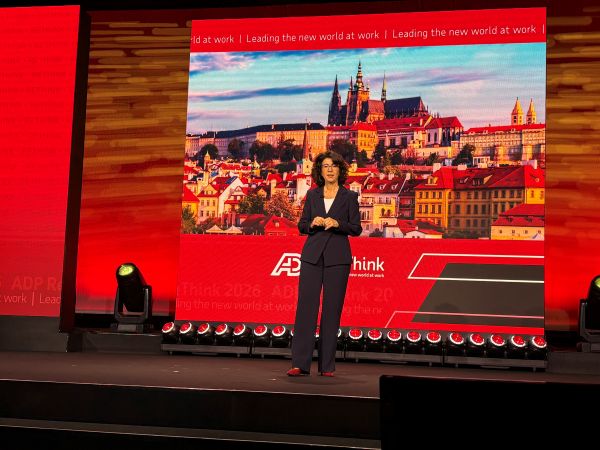
Last week in Prague, 324 people from 214 businesses across 29 countries representing 21M people gathered for ADP’s ReThink. This was a working conference, and I enjoyed that aspect of it very much. People openly discussed their corporate HR and payroll environments. I found the conversations in the hallways as useful as the ones on stage.
Senior payroll and HR leaders were saying out loud what they usually only say in private. And that meant I came back with a lot to think about. Not just about AI (which obviously dominated many conversations) but about something more fundamental: what global payroll actually is in 2026, and whether we’re still thinking about it the right way.
Maria Black, President and CEO of ADP, summarized it best in the opening keynote: “We are faced with two simple questions: What does the future of work hold and how can we in HCM keep up with all of the changes and ensure that we continue to protect the world of work.” And that really captured the spirit of the conference.
Global payroll is no longer about payroll
Here’s the thing that stuck with me most. At one point during the conference, ADP’s Virginia Magliulo (EVP, Employer Services International) said it plainly: global payroll is no longer just payroll. For me, that means it’s now core HR, payroll, time and benefits all tied together. It’s the full picture of how people are administered and paid. And that matters more than it might sound.
Because for years, many of us (myself included) have managed these domains in separate conversations, separate systems and separate vendor relationships. HR data in the global HCM Suite, payroll in a local system, time, attendance and scheduling somewhere else with lots of integrations between them sending data back and forth.
Because as we all know, to get the best results, these solutions must be deeply connected. A promotion that isn’t communicated to payroll in time creates an underpayment. A collective bargaining agreement that affects working time has direct payroll cost implications. An error in employee classification doesn’t just affect one department. It can trigger incorrect Social Security contributions, levy miscalculations and penalties across the board. These aren’t edge cases. They happen every month, in every organization, because systems and teams aren’t connected in the right way (yes, even in 2026!).
The integration gap is one of the most important things to solve before you start thinking about what AI can do for your operations. And this conference was a useful reminder of why.
Paying people around the globe
We often talk about HR and payroll in terms of processes and systems, but every “transaction” carries an emotional layer, as Sreeni Kutam (President, Global Product & Innovation) reminded us. Being promoted is a joyous occasion, but if that leads to an underpayment, that turns into irritation. Getting a new job is exciting, but if social security contributions are miscalculated, that leads to insecurity. Every action is a human experience. Data can tell us what happens and when. And AI can increasingly detect patterns between those data points and prompt thoughtful actions. But if we focus only on automation, we risk missing the human experience underneath.
One of the sessions that really brought that to the fore front was when payroll compliance experts from Singapore, Italy, Germany, Poland and Canada walked us through what local compliance actually looks like in practice. It was the kind of session that reframes your assumptions about payroll complexity quickly, even if you know this in theory.
In Italy, a certification called the DURC – which confirms a company is fully current on its Social Security and insurance contributions – can determine whether an organization is allowed to operate at all or bid for tenders. In Germany (as in other European countries), works councils have legally defined rights to be consulted before a new HR or payroll system is introduced, and they can delay or block a project if that process isn’t followed. In Poland, traditional labor regulations coexist with new EU directives like the Pay Transparency Directive, creating a compliance environment where historical context is genuinely essential knowledge to avoid mistakes. And in Canada, an employee who moves to Quebec mid-year triggers a split tax year, a different pension plan and French language documentation requirements that apply not just to external communications but to how the employer operates internally. And finally, to calculate payroll in France correctly, you need at least 150 data points per employee. That number alone tells you something important about local complexity.
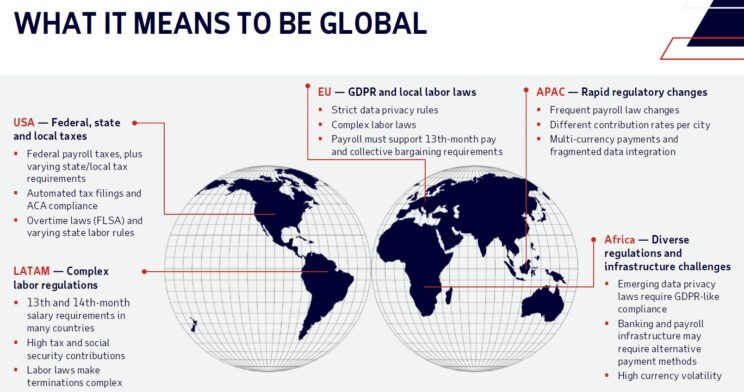
What does this mean for organizations trying to run global payroll? It means that global standardization has limits. You can harmonize processes and build consistent governance frameworks. You can consolidate your payrolls onto fewer platforms. But the local complexity doesn’t disappear. It must be built into the foundation, not bolted on afterwards. That means that the ROI of doing this properly is not just more efficiency, but also a reduction of risk. And an opportunity to serve employees better and more consistently.
Let’s talk about AI
As you’d expect, the topic of AI was everywhere at the conference. But the most interesting conversation happened during breakout sessions, when HR and payroll leaders openly talked about where they actually are with AI adoption. What I heard was sobering but not surprising, if you’ve been following corporate AI ‘success’ stories.
Most organizations are experimenting with small pilots but lack a central approach or strategy. Some employees have access to tools that other employees don’t. Some people bring their own, which creates privacy and security risks. Central, corporate training is limited, and this is especially concerning for European employers in light of the EU AI Act. Employees develop their own prompting skills through trial and error. Perhaps most telling: when asked what outcomes people were trying to achieve, the answers varied wildly. Everyone seemed to think AI makes people more productive. But not many were able to articulate why or what outcomes they measured.
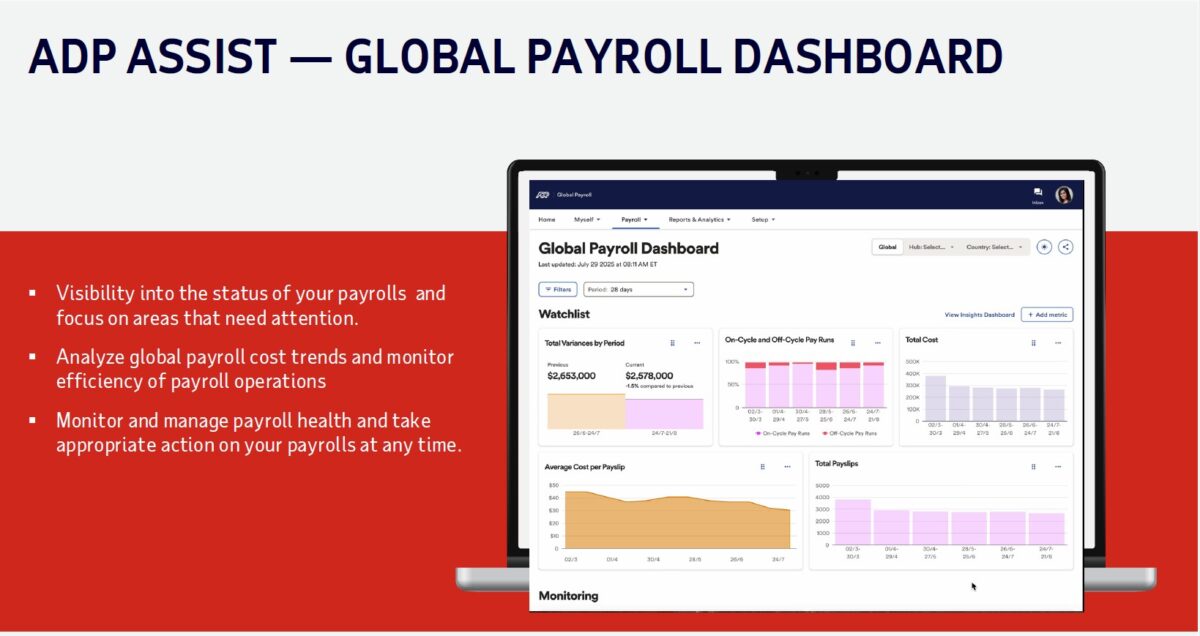
This reflects something I think about a lot. AI is genuinely useful when used correctly and with purpose. ADP’s data shows 78% of companies are now using it in some form, the fastest adoption of any technology ever recorded. But adoption isn’t transformation. And especially in payroll, the quality of your AI outputs directly depends on the quality of your underlying data. If your employee records are fragmented, if your time data doesn’t flow cleanly into payroll, if your systems aren’t integrated, then AI will only exacerbate your existing problems, not solve them.
There was a question that came up more than once during the conference and that really resonated with me: not “can we automate this?” but “should we?” That distinction matters, especially in people services. It’s technically possible to have an avatar run a job interview with a candidate. But is that the candidate experience you want to create? Maybe it would be more useful and appropriate if AI helped a candidate prepare for an interview by explaining how the company operates, what the job requires and what kind of questions to prepare for. That could save both the candidate and the company a lot of time. Time that can be spend on a genuine conversation about the role. The question of where and when to apply AI requires judgment, not just capability. And that judgment will ultimately define who you are as a company, and how you are perceived by employees.
It’s (always) about people
What brought it all together, for me, was a conversation that had nothing to do with systems. Journalist Kai Ryssdal and ADP’s Chief Economist Nela Richardson talked about the everyday economy: about Melissa, who works four jobs and doesn’t expect to retire, and Tyler, who flipped houses in a high-growth area and could (but won’t) retire at 30. Two people, same economy, completely different realities. It shows how money (or the lack of it) affects people not only today, but also where they see themselves in future. A payslip provides purpose and validation. And when people don’t have work, they feel disconnected from society.
De Ann Doonan, one of the business leaders on stage, talked about the value of payroll in crisis situations. She said something simple that I keep returning to: people know their paycheck, but not your name. Nor should they. Payroll is personal. It secures people’s housing, their meals and their other spending. It is the most tangible and regular expression of their relationship with their employer. And if you show up in a crisis and support them well, they will never forget that, even if they don’t know your name. I’ve spoken many times about this: for us in payroll, a payslip is the end of a process. For an employee, that payment is the beginning, and we should always keep that in mind.
That’s the context in which all of this payroll complexity, from compliance to integration and AI, actually lives. It’s about people being able to support themselves. Which is why getting the basics right isn’t just operational discipline. It’s also a sign of respect for the people who depend on you to get it right. It contributes to their financial well-being, and that can make all the difference.
Where we are headed
The conference reinforced something I believe and have written about before: the organizations that will get the most value from AI in HR and payroll are the ones who invest in clean data, integrated systems and clear processes. Not because AI requires perfection, but because it amplifies whatever foundation you’re building on. If that foundation is shaky, do not expect AI to cover up those mistakes. Instead, it will make highly visible what isn’t working.
I found ADP’s ReThink conference to be an insightful couple of days. The conversations were grounded, the challenges were real, and the direction of travel is clear. To be able to benefit from AI, the basics must be not almost, but exactly right.
And once they are, global payroll can become so much more than it is today: a foundation for things AI can genuinely do well. Like delivering better workforce insights and people analytics, or something as personal as helping an employee understand what they’re being paid and how to select the optimal benefits package. To make the most of what they earn. That’s when global payroll stops being a back-office function and starts being something truly insightful for the companies running it, and the people depending on its outcomes.
Full disclosure: ADP paid for accommodation, but did not compensate me for writing this article. ADP representatives were permitted to review the content for factual accuracy only; they did not have final approval or editorial control.